
In-House vs. Outsourced Mobile App Development: What Changes for Your 2027 Planning
Key takeaways
In-house mobile development means hiring platform specialists individually, iOS, Android, or cross-platform, with the ramp time and overhead that comes with any in-house hire.
Outsourced or staff-augmented mobile development draws from engineers already experienced in React Native, Flutter, or native stacks, cutting the specialist search out of your timeline.
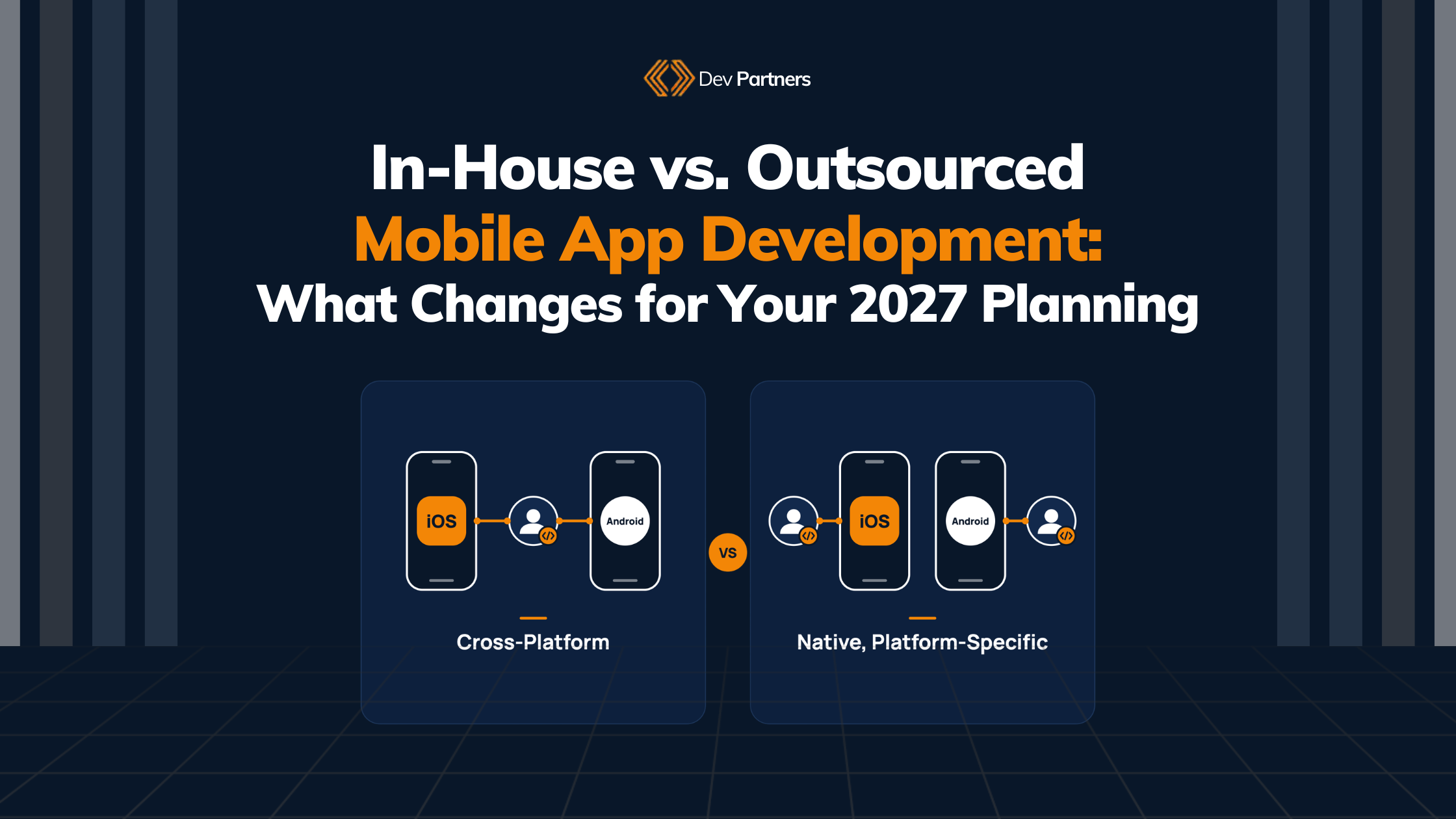
Cross-platform frameworks like React Native and Flutter let one engineer ship to iOS and Android from a single codebase, which changes how many specialists you actually need.
The real planning question for 2027 isn't just build in-house or outsource, it's whether your roadmap needs platform-specific native expertise or a cross-platform approach can cover it.
Dev Partners mobile developers work across React Native, Flutter, Ionic, and Xamarin, and can be paired with frontend web developers from the same talent pool if you need both.
Matched mobile developers integrate into your team within 14 days, with no recruitment fees and a 1:1 account manager handling HR and payroll.
If you're planning mobile development for 2027, the in-house versus outsourced question usually gets asked before a more important one: native or cross-platform. That decision changes how many specialists you actually need, which changes the entire cost and timeline conversation.
This walks through what changes operationally between in-house and outsourced mobile development, and the native versus cross-platform trade-off that should come first.
In-House Mobile Development: What It Actually Takes
Building an in-house mobile team usually means hiring platform specialists individually: an iOS developer fluent in Swift, an Android developer fluent in Kotlin, or a cross-platform generalist if you go that route instead. Each hire carries its own recruiting timeline and ramp-up period.
Outsourced or Staff-Augmented Mobile Development: What Changes
Staff augmentation draws from a pool of mobile developers who are already experienced in the frameworks you need, which removes the specialist search from your timeline. The engineer still integrates into your team and your sprint process, the same as any other augmented hire.
Native vs. Cross-Platform: Why This Decision Comes First
Planning Your 2027 Mobile Roadmap
If your app leans on deep OS-specific features, camera processing, background location, hardware integrations, native development is usually worth the extra specialist overhead.
If your priority is shipping to both platforms quickly with a smaller team, a cross-platform framework typically gets you there faster.
If you're not sure yet, a staff augmentation conversation can help you scope which approach fits your specific feature list before you commit to a hiring plan.
See available mobile development talent across React Native, Flutter, and native stacks: Hire Mobile App Developers | Dev Partners
Why Dev Partners' Approach Simplifies This Decision
Dev Partners mobile developers work across React Native, Flutter, Ionic, and Xamarin, and can be paired with frontend web developers from the same talent pool if your roadmap needs both. That means the native versus cross-platform decision doesn't have to be locked in before you start the conversation.
What to read next
Related reading:
→ Hire Frontend Developers | Dev Partners
→ Hire Full Stack Developers Philippines | Dev Partners
Planning your 2027 mobile roadmap? Talk to Dev Partners about your approach
FAQ
Should I build native or cross-platform for 2027?
It depends on your feature list. Deep OS-specific features usually justify native development despite the extra specialist overhead. If your priority is shipping to both platforms quickly, cross-platform frameworks like React Native or Flutter typically get you there faster.
Is outsourced mobile development slower to launch than in-house?
Usually the opposite, since you're not running a specialist hiring search first. Staff augmentation draws from engineers already experienced in the framework you need, which typically shortens time to first contribution.
Can one developer really cover both iOS and Android?
Yes, with a cross-platform framework like React Native or Flutter, one engineer can ship to both platforms from a single codebase. Deep native features on either platform may still need a specialist's input.
How fast can I add a mobile developer to my team?
With Dev Partners, matched mobile developers typically onboard within 14 days, since candidates are pre-vetted across the relevant frameworks before you're introduced to a profile.