
Top Software Development Companies in the Philippines (2026)
Key Takeaways
The Philippines is home to hundreds of software development companies, but quality varies dramatically between established operations and undercapitalized shops.
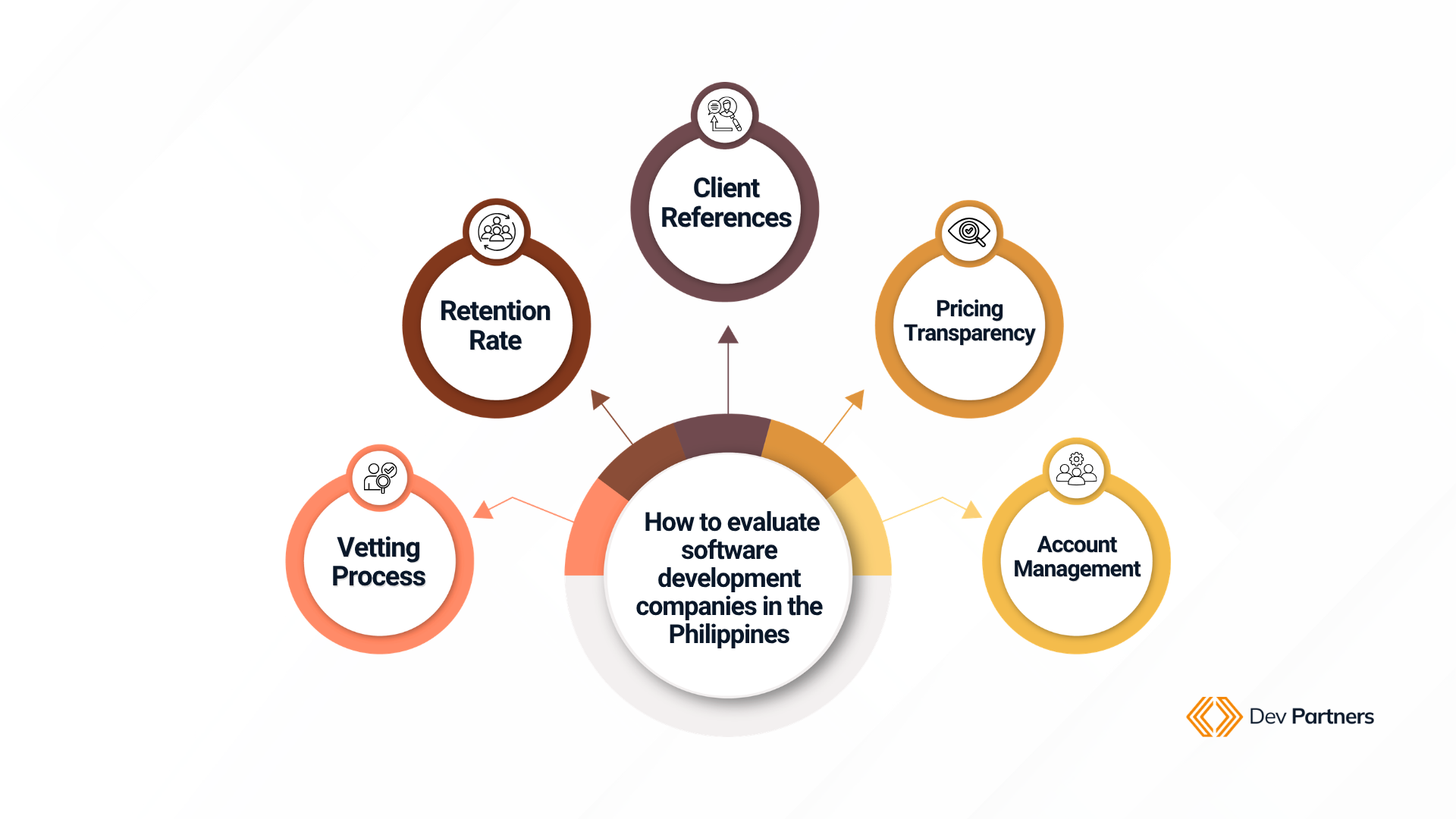
The most important evaluation criteria are vetting rigor, developer retention rate, account management model, and pricing transparency.
Staff augmentation companies (developers join your team) deliver more control and flexibility than project outsourcing firms (you hand off a scope of work).
Senior Filipino developers cost $5,000 to $9,000 per month fully loaded, which is 40 to 60% less than US equivalents at comparable quality.
Dev Partners specializes in placing the top 1% of Filipino engineers with companies in the US, UK, and Australia on flexible terms.
The Philippines has grown into one of the world's largest markets for software development outsourcing. The combination of English fluency, strong technical education, cultural alignment with Western businesses, and competitive costs has attracted companies from every industry and size. But the sheer number of software development companies in the Philippines makes it difficult to separate the serious providers from the ones that overpromise and underdeliver.
This guide helps you evaluate Philippines-based software development companies using the criteria that actually predict project success, so you can make a confident decision and avoid expensive mistakes.
Types of Software Development Companies in the Philippines
Not all Philippines-based software companies offer the same model. Understanding the differences helps you choose the right type for your needs.
Staff Augmentation Companies
These companies place individual developers or small teams directly into your existing workflow. The developers use your tools, attend your meetings, and report to your leads. You maintain full control over the work while the company handles sourcing, vetting, payroll, and HR.
Best for: Companies that need to scale their engineering team quickly without losing control over code quality, architecture, and processes. This is the model Dev Partners uses.
Project Outsourcing Firms
These companies take a scope of work and deliver a completed project. You define requirements, and the firm manages the development team, timeline, and delivery.
Best for: Companies without technical leadership who need a turnkey solution. The tradeoff is less visibility into daily work and less control over technical decisions.
Dedicated Team Providers
A hybrid model where the provider assembles a full team (developers, QA, project manager) dedicated to your project. The team works exclusively for you but is managed by the provider.
Best for: Large projects that need a self-contained team but where you don't want to manage individual developers directly.
Compare staff augmentation vs outsourcing models
How to Evaluate Software Development Companies
Vetting Process
Ask every company: how do you screen developers? Strong software development companies in the Philippines run multi-stage technical assessments specific to your stack, not generic coding tests. They evaluate English proficiency, communication skills, and cultural fit alongside technical ability.
At Dev Partners, fewer than 1 in 100 applicants pass the vetting process. Every developer is assessed on the specific technologies your project requires.
Retention Rate
Developer turnover is the hidden cost of offshore software development. If your developer leaves after 3 months and you spend 2 to 4 weeks ramping up a replacement, you've lost significant productivity. Ask for the company's monthly churn rate. Anything above 15% is a warning sign.
Dev Partners maintains sub-10% monthly churn because retention is engineered into the model through competitive compensation and career development.
Client References
Ask for at least two references from clients who have worked with the company for 6 months or longer. When you speak with them, ask about developer quality, communication, how issues were handled, and whether they'd recommend the company. Long-term relationships are the strongest signal of a reliable partner.
Get matched with a pre-vetted developer from Dev Partners
What to Pay for Software Development in the Philippines
Rates vary by seniority, tech stack, and company model. Here are the typical ranges for software development Philippines companies using a staff augmentation model:
These are all-inclusive rates through a quality provider. Rates significantly below these ranges usually indicate developers are underpaid, which drives high turnover and inconsistent quality.
See the full guide to developer hiring costs
Red Flags When Evaluating Companies
Guaranteed timelines without understanding your requirements. Any company that promises a specific delivery date before understanding your project scope is either padding the timeline or planning to cut corners.
No dedicated point of contact. If you can't get a named account manager who's responsible for your engagement, issues will go unresolved until they become emergencies.
Rock-bottom pricing. Offshore software development in the Philippines is cost-effective, but it's not free. A senior developer at $2,000 per month is either being underpaid (and will leave) or isn't actually senior.
Reluctance to share past work or references. Companies with a strong track record are eager to share it. Those that deflect reference requests usually have a reason.
No replacement guarantee. If the company won't commit to replacing a developer who isn't performing, they're not invested in the success of your engagement.
Browse our top programmer companies in the Philippines guide
Why Dev Partners Stands Out
Dev Partners is a Philippines-based IT staff augmentation company that specializes in placing the top 1% of Filipino software engineers with companies in the US, UK, Australia, and Europe.
Stack-specific vetting. Developers are tested on your exact tech stack, not generic algorithms. Fewer than 1% pass.
Sub-10% churn. Developers stay because they're compensated well, supported professionally, and invested in long-term.
14-day placement. A pre-vetted bench means you're not waiting months. Candidates are ready within 2 weeks.
1:1 account management. A dedicated point of contact monitors performance, facilitates communication, and handles issues proactively.
Flexible terms. Minimum 3-month engagement. No long-term lock-in. Scale up or down as your project demands change.
Apply to hire developers through Dev Partners
FAQ
How do I choose between a staff augmentation company and a project outsourcing firm?
If you have technical leadership in-house (CTO, tech lead, engineering manager), staff augmentation gives you more control and better results. If you don't have technical leadership and need someone to manage the entire development process, project outsourcing may be more appropriate.
Can Philippines-based companies handle enterprise-scale projects?
Yes. The Philippines' IT industry supports projects for Fortune 500 companies across finance, healthcare, retail, and technology. The key is choosing a company with proven experience at that scale and strong project management practices.
What if I need a very specialized tech stack?
The Philippines has strong depth in mainstream stacks (React, Node.js, Python, Java, .NET, mobile). For highly specialized needs (Rust, Elixir, niche ML frameworks), the talent pool is smaller. Discuss your specific requirements with the provider early to confirm availability.
How does IP protection work with Philippine software companies?
Reputable providers include NDAs and IP assignment clauses in standard contracts. The Philippines is a signatory to major international IP agreements. Dev Partners handles all IP protection as part of the standard engagement process.