
Outsourcing Software Development for Startups: When It Works and When It Does Not
Startups face a paradox. You need engineering talent to build your product, but you cannot afford to hire a full team at US or European salaries while you are still finding product-market fit. Outsourcing software development solves this problem, but only when it is done correctly.
This guide covers when outsourcing makes sense for startups, the risks you need to manage, and how to structure the engagement so you keep control of your product while accessing the talent you need.
Why Startups Outsource Development
The math is straightforward. A senior full-stack developer in San Francisco costs $180,000 to $220,000 per year in salary alone. Add benefits, equity, office space, and recruiting costs, and you are looking at $250,000 or more per engineer.
An equally skilled developer in the Philippines costs $60,000 to $108,000 per year, fully loaded. That is the same talent at 40 to 50% of the cost, which means your runway stretches further and you can hire more engineers for the same budget.
But cost savings alone do not make outsourcing the right decision. The real value is in the combination of cost efficiency, speed, and flexibility.
Speed
Hiring locally takes 3 to 6 months when you factor in sourcing, interviewing, offer negotiations, and notice periods. A good staff augmentation partner can place a vetted engineer on your team within 14 days. For startups racing to launch an MVP or hit a funding milestone, that speed difference is critical.
Flexibility
Startups pivot. Your technical requirements will change as you learn from users and iterate on your product. Outsourcing lets you scale up when you need more capacity and scale down when you do not, without the cost and complexity of hiring and firing full-time employees.
Access to Specialized Skills
Your startup might need a machine learning engineer for three months, a mobile developer for two months, and a DevOps specialist for one month. Building that kind of specialized bench in-house is impractical. Outsourcing gives you access to specialists on demand.
When Outsourcing Works for Startups
Outsourcing is not a universal solution. It works best in specific situations:
You have a technical co-founder or CTO. Someone on your founding team needs to own the technical vision, review code, and make architecture decisions. Outsourcing the building does not mean outsourcing the thinking.
Your requirements are defined enough to communicate. You do not need a 200-page spec, but you do need clear user stories, wireframes, or prototypes. If you cannot explain what you want built, no external team will figure it out for you.
You are building a product, not exploring an idea. If you are still validating whether there is a market for your product, outsourcing a full development team is premature. Start with no-code prototypes or a small proof-of-concept first.
You need to preserve runway. If hiring 3 US-based engineers would consume 18 months of your runway but outsourcing the same capacity would only use 8 months, outsourcing gives you more room to iterate and find product-market fit.
When Outsourcing Does Not Work for Startups
Be honest with yourself about these scenarios:
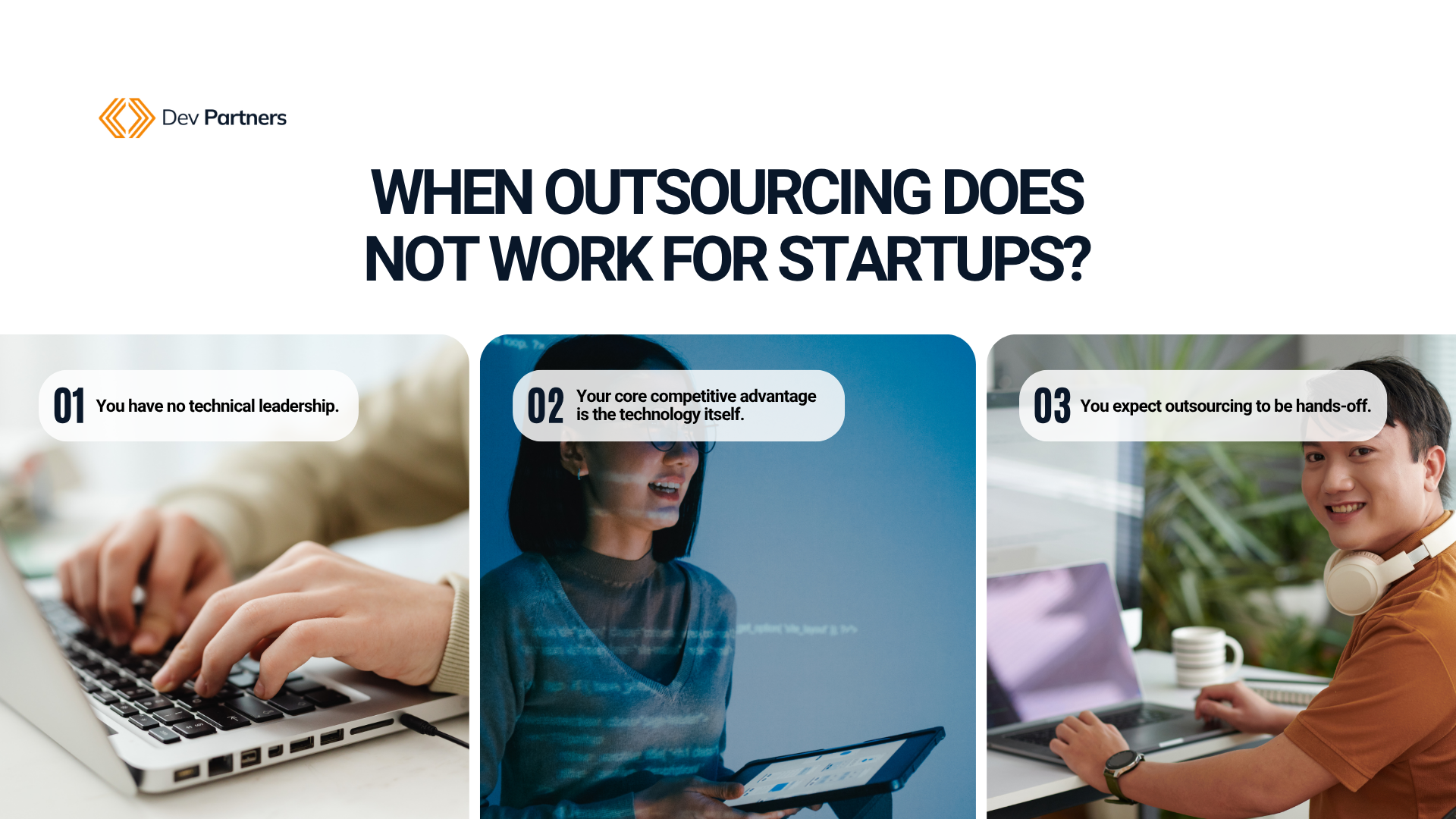
You have no technical leadership. Outsourcing code without someone who can evaluate quality, architecture, and security is a recipe for technical debt that will cost you more to fix than it cost to build.
Your core competitive advantage is the technology itself. If your differentiation is a proprietary algorithm, an innovative UX pattern, or a novel technical approach, you probably need that expertise in-house where it is tightly integrated with your product vision.
You expect outsourcing to be hands-off. Managing an outsourced team requires the same management practices as an in-house team: clear communication, regular check-ins, code reviews, and feedback. If you are not willing to invest that time, the engagement will underperform.
How to Structure the Engagement
Choose Staff Augmentation Over Project Outsourcing
Startups should strongly consider staff augmentation over traditional project outsourcing. With project outsourcing, you hand off a scope of work and hope the external team delivers. You lose visibility into the daily work, the code quality, and the decision-making.
With staff augmentation, the engineers join your team. They attend your standups, work in your codebase, use your tools, and report to your technical lead. You maintain full control while accessing external talent.
How staff augmentation compares to outsourcing.
Start Small and Scale
Do not hire 5 engineers on day one. Start with 1 or 2 developers on a focused task. Evaluate their performance, communication, and code quality over the first 30 days. If they meet your standards, add more. If not, work with your provider to make replacements before scaling.
Invest in Onboarding
Treat outsourced engineers the same way you would treat new full-time hires. Give them access to documentation, introduce them to the team, walk them through the codebase, and set clear expectations for communication and delivery. Companies that skip this step consistently report lower satisfaction with outsourced talent.
Protect Your IP
Work with your legal team to ensure proper NDAs and intellectual property agreements are in place before any code is written. Reputable staff augmentation partners handle this as part of their standard contracting process.
The Philippines as a Startup-Friendly Destination
For startups with US, Australian, or European founders, the Philippines offers a particularly strong combination of quality, cost, and cultural alignment.
Filipino engineers are educated in rigorous computer science programs, speak fluent English, and are familiar with Western business practices. The time zone overlap with US West Coast hours (when working afternoon shifts) makes real-time collaboration practical.
Dev Partners specializes in placing top 1% Filipino engineers with growing companies. The model is built for startups: flexible terms starting at 3 months, transparent monthly pricing, 1:1 account management, and a replacement guarantee that protects your investment.
Apply to hire a developer through Dev Partners.
Frequently Asked Questions
How much does it cost to outsource software development for a startup?
For Philippines-based senior engineers, expect $5,000 to $9,000 per month fully loaded. A team of 3 engineers would cost $15,000 to $27,000 per month, compared to $50,000 or more for the same team in the US.
Can startups outsource their entire development team?
Technically yes, but it is not recommended unless you have a strong technical co-founder or CTO managing the team. At minimum, your core technical leadership should be in-house.
How do I maintain code quality with an outsourced team?
The same way you maintain it with an in-house team: code reviews, automated testing, CI/CD pipelines, and clear coding standards. Your technical lead should review all pull requests, regardless of who wrote the code.
What happens if a developer is not working out?
Quality providers offer replacement guarantees. Dev Partners will replace any engineer who is not meeting expectations at no additional cost, typically within 14 days.
Book a free strategy call with Dev Partners.